Retail catalog, compliance review, and storefront polish
Wholesale catalog refinement, inventory-management groundwork, a restricted-product review experience, and a more coherent storefront modal system.
July 12, 2026
This update moves the prototype from a small hand-built catalog toward a real, manageable retail inventory. Using the approved Skokie Wholesale public inventory as a starting point, the work preserves the original supplier details while turning wholesale packages into shopper-facing products, reviewable prices, and dependable product imagery. New records remain drafts until they have been reviewed for accuracy, presentation, and sale eligibility.
The same pass introduces a clearer compliance boundary. A small set of non-inhalable CBD products remains visible in the main catalog for documentation review, while THCA and other restricted or ambiguous cannabinoid records move to a separate, non-commerce review experience. Age verification, the cart, and checkout now use one coordinated dialog system so each step feels like part of the same storefront.
Catalog at a glance
| Catalog stage or surface | Products | Variants | Commerce state |
|---|---|---|---|
| Raw wholesale scrape | 2,201 | 6,868 | Source evidence only |
| Normalized retail catalog | 1,323 | 3,003 | Staging and review only |
| KOF operational inventory | 1,046 | 2,069 | General products imported as drafts |
| Main storefront surface | 1,051 | 2,084 | General products enabled; CBD candidates locked |
| Restricted review surface | 272 | 919 | No products enabled |
Four supplier variants are marked available but have no usable price. They remain in the review record and are excluded from the shopper-facing catalog.
Source catalog and image reliability
The original wholesale catalog remains intact as a reference. Product titles, descriptions, supplier references, package tiers, availability, tags, and image details can all be traced back to the source when a product needs review.
Images use a source-first delivery strategy:
- Public Shopify images remain the primary source while the supplier keeps them available.
- A local image mirror provides a fallback if a supplier image becomes temporarily unavailable.
- Original image references are retained so media can move to dedicated hosted storage later.
- Both storefront experiences share the same fallback behavior for a more consistent catalog.
This keeps product pages fast today while preserving a practical path to fully managed media hosting later.
Retail-unit and price normalization
Wholesale package counts can describe several different things: a consumer package, an outer display, a case, or an item that is already unit-priced. The new retail conversion treats those counts as context instead of assuming every number should divide the price.
Examples of the current rules include:
4pk - 10ct Boxbecomes one retail 4-pack at one tenth of the outer-box cost.20pk - 12ct Displaypreserves the shopper's 20-pack and divides by the 12 display units.- A consumer
75ct Boxcan remain one retail package rather than becoming 75 loose items. - Parenthetical case text can remain unit-priced when the source price already describes one item.
- Duplicate supplier package tiers collapse into one retail choice while retaining the original supplier references for traceability.
Each conversion keeps the original wholesale price, package count, estimated per-unit cost, suggested price, confidence level, and reason for the decision. Ambiguous products are flagged for manual correction without changing the original supplier record, and previous review reports are retained as the rules improve.
Most importantly, an estimated unit cost never becomes an approved retail price automatically. Supplier MSRP is preferred when available, and every cost-derived suggestion remains clearly marked for review.
Inventory management foundation
The catalog is now structured for day-to-day management through the upcoming client dashboard. Only the 1,046 general products enter that system, and they enter as drafts rather than appearing automatically in the storefront. CBD-review and restricted-cannabinoid records are excluded before the database import, giving the delivered inventory tool a clear and intentionally narrow scope.
The inventory foundation supports:
- product names, descriptions, categories, options, and images
- separate supplier costs and customer-facing retail prices
- draft, review, and published product states
- location-level stock and a history of inventory adjustments
- team access that can grow with future dashboard roles
Future supplier updates can refresh availability, costs, and source details while preserving names, descriptions, retail prices, publication decisions, and stock counts already managed by the team. This keeps routine catalog refreshes from overwriting intentional merchandising work.
Internal supplier costs and management records remain separate from the public catalog. Stock changes are recorded as accountable adjustments instead of silent number replacements, preserving a useful history for later review. Together, these pieces establish a controlled path from supplier data to dashboard review and finally to the live storefront.
Legal research and catalog policy
The preliminary legal research produced working catalog guardrails, not a declaration that any specific supplier product is lawful to sell. Product-specific COAs, formulation, packaging, labels, licensing, fulfillment, and counsel review still determine whether commerce can be enabled.
The current working interpretation for Illinois is:
- Beginning November 12, 2026, a final consumer hemp cannabinoid product must contain 0.4 milligrams or less of total THC per container, including THCA and other cannabinoids treated as intoxicating.
- Products in this lane must be consumable or topical; smoked, inhaled, vaped, or e-cigarette forms do not qualify for the main-store CBD review lane.
- A storefront 21+ confirmation is a browsing control. It is not the independent public-record age verification required for regulated remote tobacco transactions.
Primary references: Illinois Public Act 104-0463, IDFPR SB 3222 fact sheet, and Illinois Public Act 103-0937.
The catalog now derives one of three dispositions for every product:
| Disposition | Surface | Default commerce status |
|---|---|---|
| General merchandise | Main storefront | Enabled |
| Non-inhalable CBD candidate | Main storefront | Documentation review required |
| Restricted or ambiguous cannabinoid product | THCA Reserve | Not for online sale |
Only five supplier records currently meet the conservative CBD-candidate filter: two product lines of gummies in multiple package sizes, one tincture, one salve, and one additional gummy line. They remain visible but cannot be added to the cart. Checkout validates the restriction again, so an old or manually altered browser cart cannot bypass the storefront status.
Twelve generic batteries and mods had inherited broad CBD or delta supplier tags. Those records are
now normalized back to Accessories instead of being represented as cannabinoid products. Hemp
wraps and cones remain in review because their treatment should not be inferred from supplier tags
alone.
THCA Reserve compliance demo
THCA Reserve is intentionally a product-review experience rather than a second live store. It uses the existing product imagery and catalog language, introduces a distinct green accent, and keeps every record visibly locked.
| Desktop | Mobile |
|---|---|
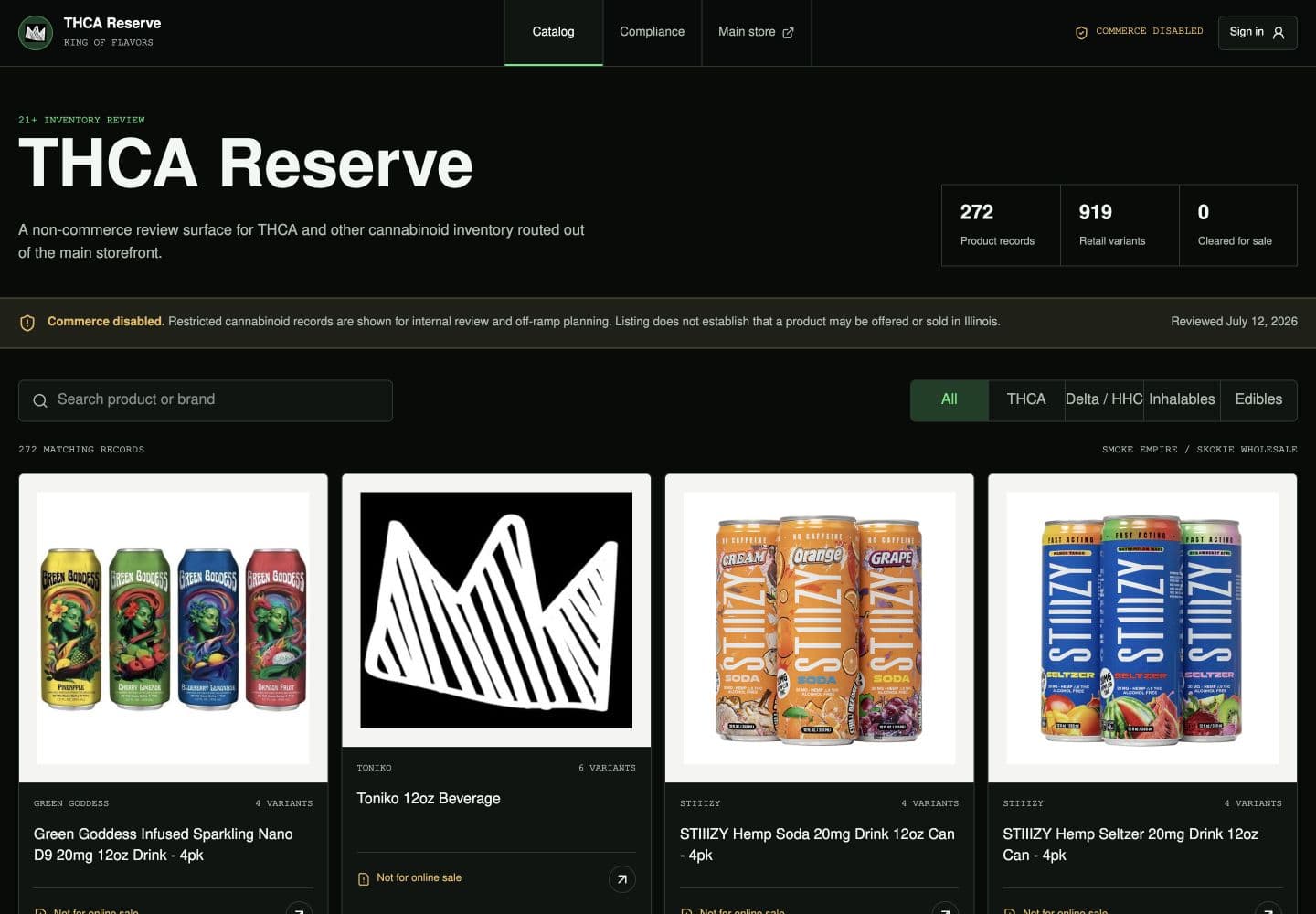 | 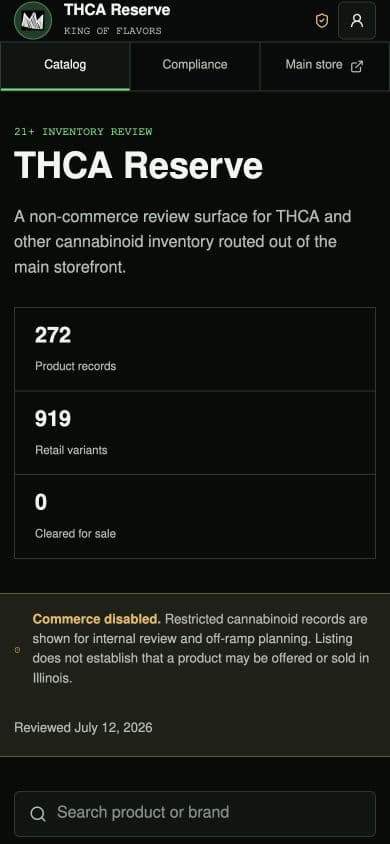 |
The demo includes:
- search and filters for THCA, delta/HHC, inhalable, and edible products
- product review pages with COA, label, QR, and Illinois eligibility checkpoints
- hidden pricing, disabled purchase actions, and zero products cleared for sale
- a separate sign-in flow so the experience can be operated independently
- responsive catalog browsing designed for both desktop and mobile review
Keeping the experience separate allows restricted products to be reviewed without blending them into the main smoke-accessory catalog. It also leaves a clear off-ramp for products that cannot be supported by the final compliance and documentation requirements.
One coordinated modal experience
The main storefront now presents one modal at a time. Age verification has priority, while cart and checkout states become available only after verification and only where shopping is enabled.
| Desktop | Mobile |
|---|---|
 | 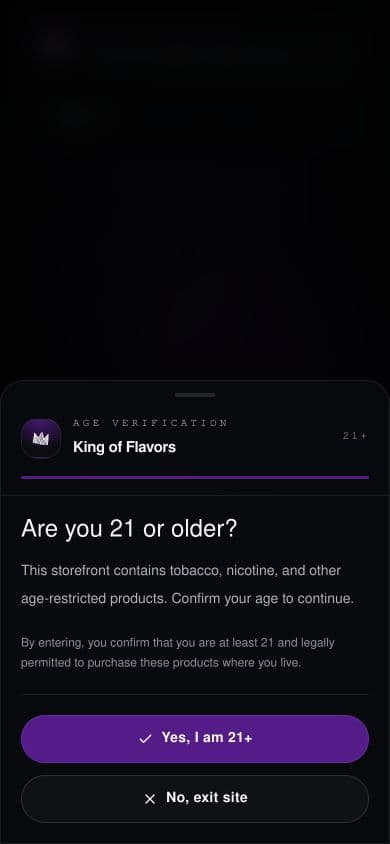 |
This removes the earlier possibility of age verification, sign-in, the cart, and checkout appearing as competing layers. The coordinated experience now provides:
- consistent backdrop and panel motion between states
- keyboard focus that stays within the active dialog and returns to the correct control afterward
- page scroll protection while a dialog is open
- intentional starting focus for each step
- dismissal rules appropriate to verification, cart, checkout, and payment processing
The verification state deliberately covers the header to distinguish it from ordinary store dialogs. After confirmation, the age panel exits before the requested auth or storefront surface fades in. The buttons use the existing primary and secondary component language with corrected icon and label centering rather than introducing a separate visual system.
Storefront refinements
Several supporting changes make the larger catalog feel more dependable:
- The main storefront and restricted review catalog are isolated from one another.
- Checkout always validates against the customer-facing catalog, never the review catalog.
- Shopify images remain primary with local fallback behavior in both experiences.
- Product grids load in manageable groups for smoother browsing through the larger catalog.
- The home page uses a focused featured set instead of processing the entire inventory at once.
- CBD candidates replace purchase actions with a clear documentation-review status.
- Navigation now supports a deliberate handoff between the main catalog and THCA Reserve.
Quality checks
The expanded quality checks now cover age-verification persistence and modal priority, retail-unit conversion, separation between catalog experiences, CBD checkout rejection, draft-first inventory loading, and protection against accidental overwrites.
At the close of this pass:
- 32 project tests pass.
- Automated checks pass across the shared catalog, storefront, checkout, and review experience.
- Production builds pass for both the main storefront and THCA Reserve.
- Desktop and mobile browser checks show no horizontal overflow or broken catalog images.
The next operational step is not to publish the entire supplier feed. It is to complete the inventory-management setup, load the 1,046-product operational catalog as drafts, review suggested prices, and activate only products with a defensible retail record.
Production catalog migration, managed media, and storefront continuity
The operational catalog now lives in Supabase as drafts, product media is moving into managed Storage, and storefront navigation preserves pagination and scroll position.
Splash simplification and favicon polish
Full-viewport storefront splash refactor, mobile header cleanup, and a generated squircle favicon.